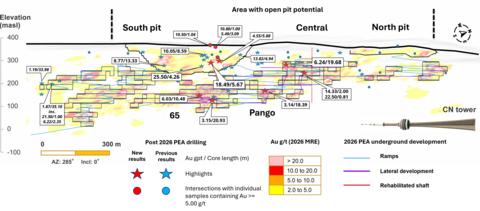
Lode Gold Resources Inc. announced today that it has identified structural patterns controlling gold grade distribution at the Pine Tree-Josephine Mine within its Fremont Gold Mine in Mariposa County, USA. The interpretation is based on the digitization, completed earlier this year for the 2026 Mineral Resource Estimate (MRE), of an extensive portion of the historical Pine Tree underground level containing channel samples collected in 1941, integrated with historical drilling results and the Company's geological interpretation of the Pine Tree and Josephine vein systems. Figure 1. Historical Pine Tree-Josephine mine workings and newly digitized data. The highlighted area indicates the section incorporated into the updated geological interpretation. To view an enhanced version of this graphic, please visit: https://images.newsfilecorp.com/files/4064/322236_db7766c3048d9b0c_001full.jpg The integrated dataset indicates the presence of at least two higher-grade mineralization shoots along the Pine Tree vein, each approximately 50-60 metres long and associated with grades of approximately 4-6 g/t Au. These shoots occur in predictable structural positions relative to transverse normal faults. The adjacent Josephine vein was barely explored in this area during the historical underground operation, although a later drill hole intersected 43.02 g/t Au over 0.61 metres, approximately 26 metres from a crosscut developed to intersect the vein. The Company believes that understanding these structural relationships could help identify underexplored zones with potential for higher grades and additional gold content, including at depth. Hashim Ahmed, Director and Chair of the Board of Lode Gold, commented: "The strategy pivot to bulk underground mining is central to a lower-cost operation. With the significant increase in the price of gold since the previous MRE, the cut-off grade has decreased to 0.82 g/t Au for economic extraction. This approach allows a greater proportion of the deposit, including lower-grade material, to be considered in the resource estimate." Continuous Underground Sampling Reveals Structural Controls The historical channel samples provide continuous sampling along exposed mineralized structures in the underground workings, allowing the Company to examine changes in the vein geometry and grade distribution in greater detail than would be possible from drill intersections alone. This dataset has revealed a recurring relationship between transverse normal faults and changes in the orientation of the Pine Tree and Josephine veins. Figure 2. Structural controls on Pine Tree-Josephine mineralization. Higher-grade shoots occur before transverse faults along Pine Tree and after them along Josephine. To view an enhanced version of this graphic, please visit:…