News release
Andina Copper Confirms High-Grade, Near-Surface Copper
Discuss on
 $ANDC.V
Loading live prices…
Loading live prices…
Vancouver, British Columbia--(Newsfile Corp. - November 5, 2026) - Andina Copper Corporation (TSXV: ANDC) (FSE: FIR) (OTCQB: PMMCF) ("Andina" or the "Company") is pleased to report further high-grade, near-surface drill results at its Cobrasco porphyry copper-molybdenum discovery located in Chocó, Colombia.
Drillhole CDH014 was drilled steeply to the northeast from the same pad as CDH013 (refer September 23, 2026 News Release) and intersected further high-grade mineralization from 52 meters ("m") downhole, confirming the extension of shallow, high-grade mineralization to the northwest of the previous drillpad.
Cobrasco is a major new porphyry copper discovery in the early stages of evaluation. With fourteen holes and approximately 11,000m of drilling reported to date, drilling has outlined a large volume of copper mineralization within an open footprint of approximately 1,300m x 550-700m (Figures 1 and 2). In the northwestern part of that footprint, CDH014 intersected 76 m at 1.00% Cu from 52m downhole, including 32m at 1.48% Cu from 60m downhole.
Drilling is ongoing with assay results from an additional 3,000m still pending. Mobilization of a second drill rig to target further expansion of the high-grade part of the system is expected within the quarter, while the current drill rig continues to extend the broader mineralized envelope.
HIGHLIGHTS:
- Hole CDH014 intersected:
212m at 0.50% Cu, 112ppm Mo, 1.9g/t Ag from 52m
including 76m at 1.00% Cu, 191ppm Mo, 2.9g/t Ag from 52m
including 32m at 1.48% Cu, 272ppm Mo from 60m
- Drilled from the same pad as CDH013, CDH014 supports continuity of the high-grade, near-surface copper mineralization intersected in CDH013 in the northwestern part of the drill-defined footprint.
- Highest grades of 1.48% Cu, 272ppm Mo occur over 32m from 60m in microdiorite and magmatic-hydrothermal breccia, with individual 2m samples returning up to 2.59% Cu.
- The Cobrasco mineralized system remains open in multiple directions.
Joseph van den Elsen, Andina Copper President and CEO stated:
"Drillhole CDH014 confirms the continuity of the high-grade, near-surface mineralization intersected in CDH013, returning 76m at 1.00% Cu, 191ppm Mo from 52m downhole, including 32m at 1.48% Cu, 272ppm Mo from 60m downhole. Importantly, these two holes have extended the shallow, high-grade mineralization approximately 350m northwest of earlier drilling.
With multiple holes recently completed outside the drill defined footprint of approximately 1,300m x 550-700m footprint and drilling ongoing, we are accelerating exploration and further define the scale of this exciting high-grade, near-surface porphyry system."
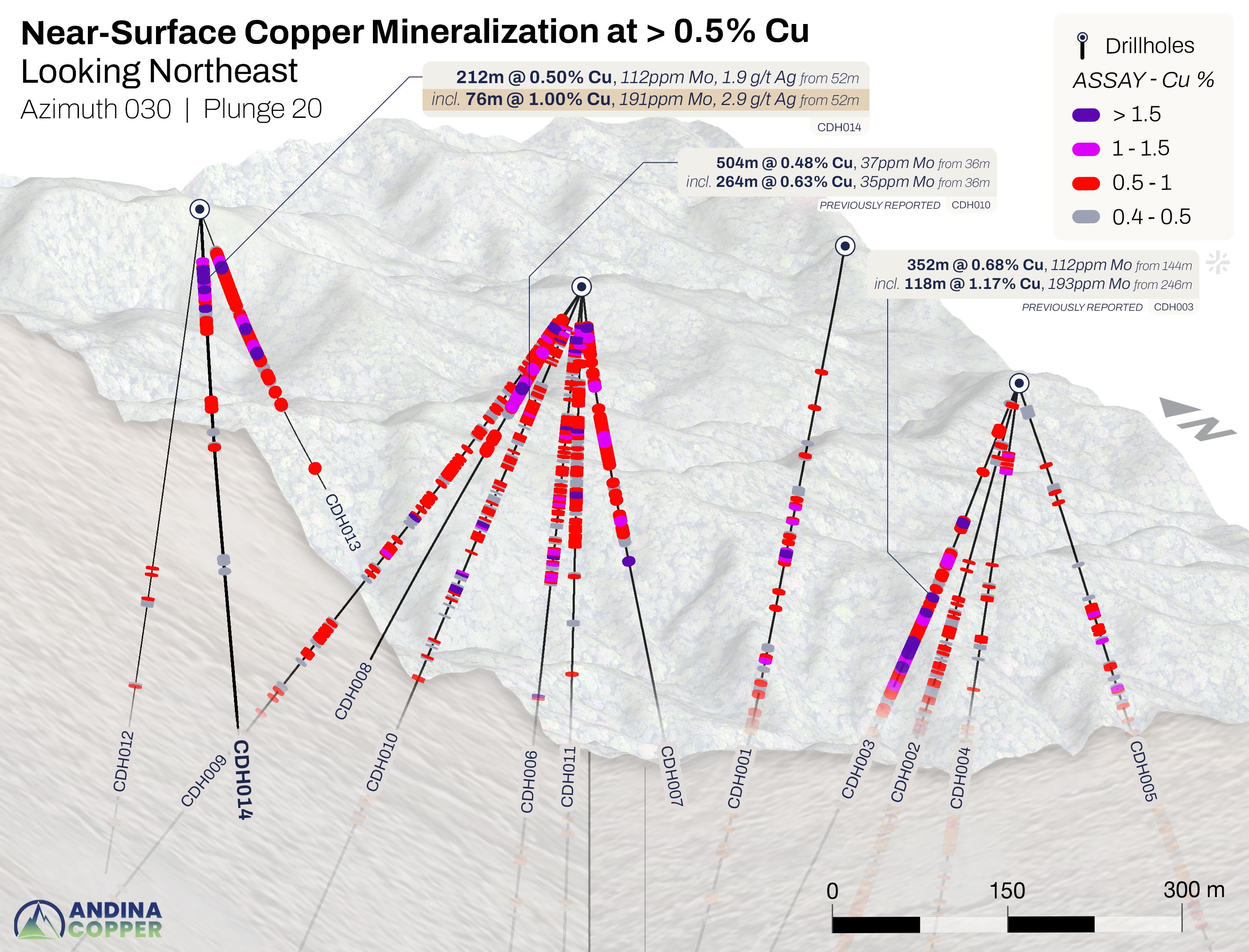
Figure 1: Cobrasco Project oblique view showing near-surface copper mineralization at > 0.5% Cu, looking Northeast, showing drillhole traces with downhole Cu assays.
To view an enhanced version of this graphic, please visit:
https://images.newsfilecorp.com/files/12760/322646_52363fd4641168a5_001full.jpg
Geology and Mineralization
Drillhole CDH014
Hole CDH014 (azimuth 45°; dip −80°; final depth 565.95m) was collared approximately 350m northwest of the previous pad and drilled steeply northeast along the same northeast-southwest section as CDH012 and CDH013. The hole was designed to test the near-surface and vertical continuity of the mineralization intersected in CDH013.
CDH014 intersected saprolite and a transition zone to approximately 16m downhole, underlain by oxidized intrusive breccia developed at the contact between rhyolite porphyry and microdiorite containing iron oxides after sulfides to approximately 52m. Copper sulfide mineralization commences at approximately 52m within microdiorite and magmatic-hydrothermal breccia and is represented by chalcopyrite - bornite, partially replaced by supergene chalcocite. Copper sulfides occur as disseminations, patches and hairline fracture fillings, locally accompanied by molybdenite. Supergene chalcocite was observed from approximately 52m to 104m, indicating a degree of supergene enrichment immediately below the base of oxidation. This interval hosts the highest copper grades intersected to date from this pad, including 32m at 1.48% Cu and 272ppm Mo from 60m, with individual 2m samples returning 2.59% Cu from 62m, 2.27% Cu from 64m and 1.96% Cu from 82m.
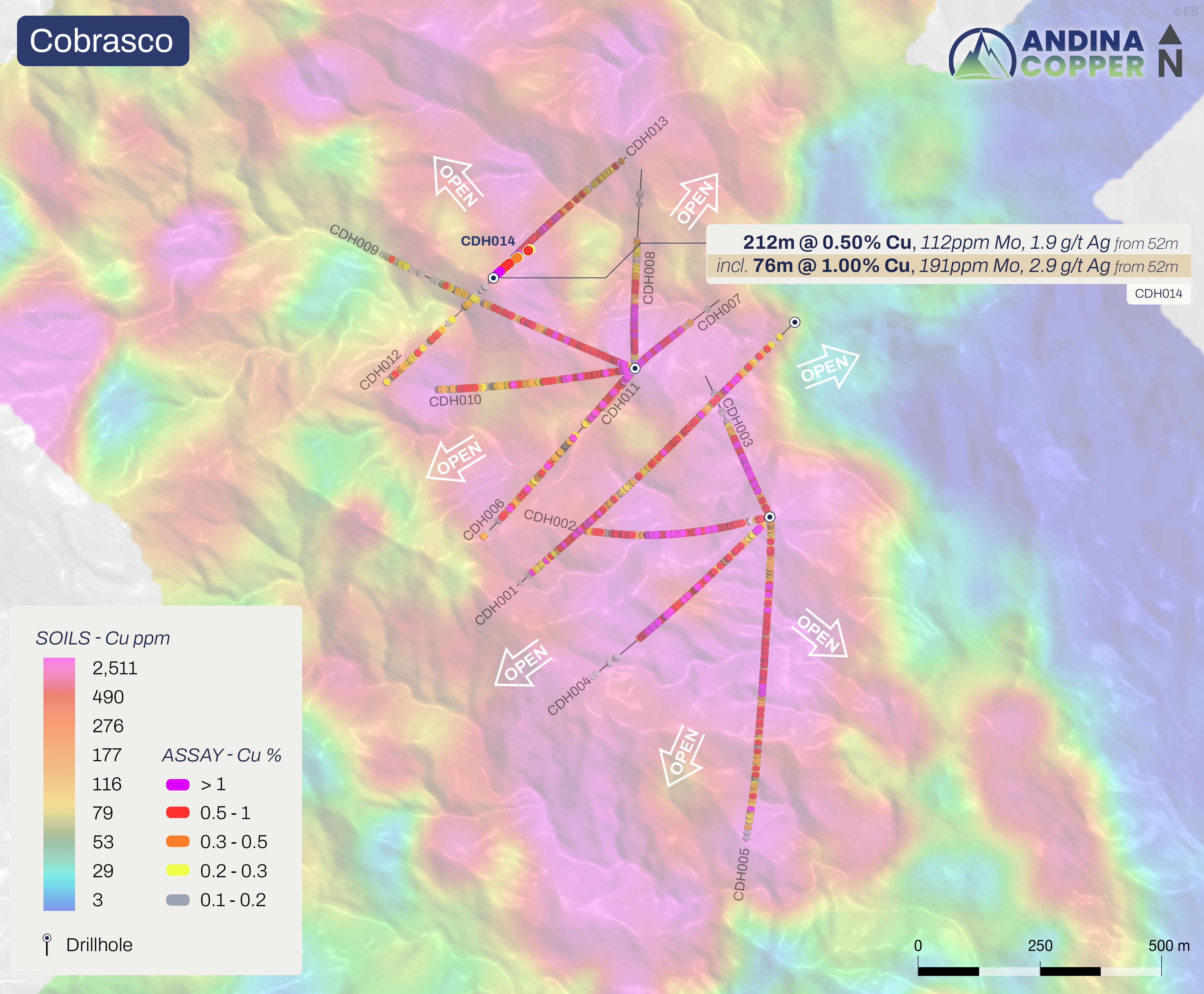
Figure 2: Cobrasco Project plan view showing copper-in-soil geochemistry, drillhole traces with downhole Cu assays. The CDH014 intercept is labeled. The mineralized system remains open in multiple directions.
To view an enhanced version of this graphic, please visit:
https://images.newsfilecorp.com/files/12760/322646_52363fd4641168a5_002full.jpg
Below approximately 104m, mineralization continues within magmatic-hydrothermal breccia as disseminated chalcopyrite and pyrite with molybdenite veinlets and local sphalerite on fractures, before the breccia passes into quartz-eye rhyolite porphyry at approximately 130m. Between approximately 130m and 200m, copper grades decrease within rhyolite porphyry carrying disseminated chalcopyrite and pyrite with molybdenite on fractures, consistent with the pattern observed in CDH013, where copper mineralization is weaker within the rhyolite porphyries than in the microdiorites and magmatic-hydrothermal breccia. From approximately 200m, grades increase again within a fault zone and adjacent rhyolite porphyry carrying disseminated chalcopyrite and bornite, with bornite partly replacing chalcopyrite between approximately 246m and 252m. Below approximately 264m, copper grades decrease to below 0.2% Cu within rhyolite porphyry carrying trace disseminated chalcopyrite and pyrite with molybdenite in quartz veinlets. A lower zone of weaker copper mineralization, with chalcopyrite and bornite as disseminations and on fractures within sericite-altered rhyolite porphyry and an associated fault zone, is developed from approximately 364m downhole.
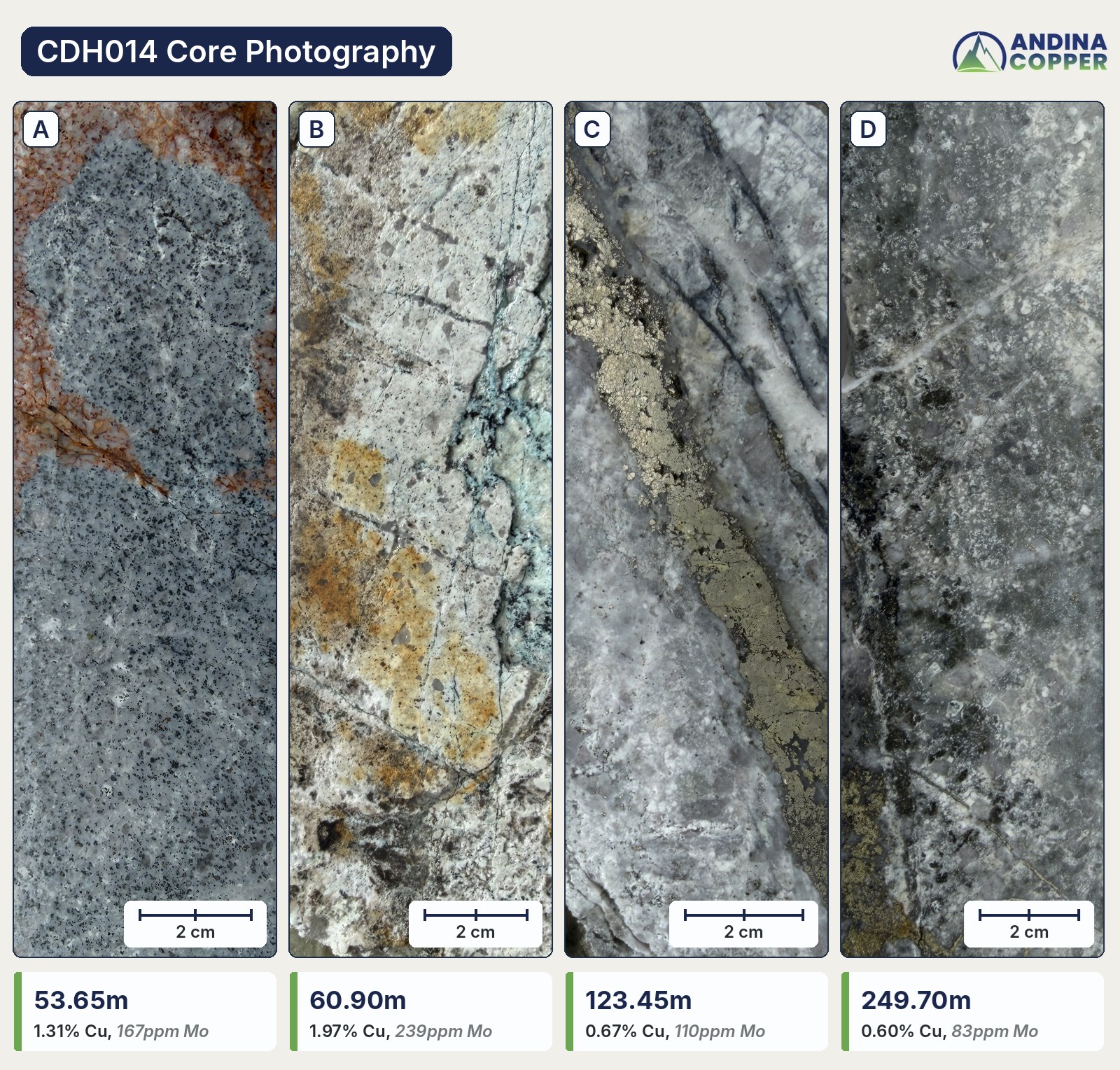
Figure 3: Representative core from CDH014, with depths and corresponding 2m assay results as labelled.
- Fine grained rhyolite porphyry with quartz eyes at 52-54m, near the top of the mineralized zone, with moderate sericitic alteration and disseminated chalcopyrite-bornite partly replaced by supergene chalcocite; iron oxides occur along fractures.
- Monomict magmatic-hydrothermal breccia at 60-62m with moderate sericitic alteration overprinting potassic (secondary biotite) alteration of the matrix; chalcopyrite occurs as disseminations in clasts and matrix and as fracture fillings, with patches of chalcocite in the matrix.
- Magmatic breccia with vein fragments at 122-124m, with moderate sericitic alteration; chalcopyrite and pyrite occur in bands and as disseminations in the matrix, with molybdenite veinlets.
- Quartz-eye rhyolite porphyry at 248-250m with moderate sericitic alteration overprinting potassic alteration; chalcopyrite occurs as disseminations, patches and veinlets, with patches of magnetite and anhydrite-chalcopyrite veinlets.
To view an enhanced version of this graphic, please visit:
https://images.newsfilecorp.com/files/12760/322646_52363fd4641168a5_003full.jpg
The Company's Corporate Presentation is available at: Andina Copper Corporate Presentation
Interested parties can subscribe to our mailing list and follow our social media channels in the links below:
Mailing List | Andina Copper LinkedIn | Andina Copper X
ON BEHALF OF THE BOARD
Joseph van den Elsen
President & Chief Executive Officer
joseph@andinacopper.com
Jordan Webster
VP - Technical Communications
jordan@andinacopper.com
Shae Frosst
VP - Investor Relations
shae@andinacopper.com
QUALIFIED PERSON
Gustavo Zulliger, a consultant of Andina Copper Corp and a "qualified person" ("QP") within the definition of that term in National Instrument 43-101, Standards of Disclosure for Mineral Projects, has reviewed and approved the technical information contained in this news release. Gustavo Zulliger is a Certified Professional Geologist with the American Institute of Professional Geologists (CPG #11165).
QAQC
CDH014 was collared with a PQ-size drill string and reduced to HQ at 128.05m downhole, continuing to a final depth of 565.95m. The drill core was extracted from the core barrel by the drill contractor under the supervision of Andina Copper personnel and placed in core boxes with appropriate depth markers (core blocks) and padding for additional protection during transport. Full core boxes were then strapped closed before being transported to the Cobrasco core cutting facility in Quibdó. The drill core was cleaned where required, marked and photographed, prior to undergoing geotechnical and preliminary geological logging. All core segments were cut by diamond saw by Andina Copper technicians, other than the soft upper oxidized, near-surface intervals that could be cut and sampled using hand tools. All sampling was conducted in nominal 2m intervals with cut-lines marked by the supervising geologists to ensure representative sampling. Samples were placed in plastic bags with non-repeatable sample tags and bagged in woven polypropylene sacks ready for transport. The core trays containing the remaining half-core are stored at the Andina Copper facility in Quibdó for additional technical measurements, including TerraSpec spectral analysis, magnetic susceptibility and rock-density measurements, and for follow-up detailed geological logging. From Quibdó, core samples were sent to the ALS sample-preparation facility in Medellín. Prepared sample pulps were then forwarded to the ALS analytical laboratory in Lima, Peru. ALS is independent of the Company. Samples were analyzed for gold using method Au-AA23, for multiple elements using method ME-MS61, and for overlimit values using method ME-OG62, including Cu-OG62 for copper. Coarse and fine rejects are routinely returned by ALS Medellín for storage at the Andina Copper storage facility. The Company's QA/QC program includes the systematic insertion of certified reference materials, coarse and fine blanks, coarse-reject duplicates and pulp duplicates into the sample stream. Each standard 80-sample submission comprises approximately 70 primary samples and 10 control samples, representing a control-sample insertion rate of approximately 12.5%. Control-sample results are reviewed on a batch-by-batch basis to monitor analytical accuracy, potential contamination and precision. The Company reviewed all analytical batches associated with drillhole CDH014 as part of its quality assurance and quality control (QA/QC) program. The review identified no issues that materially affected the reported drill intervals, and the Company accepted all CDH014 analytical batches for reporting.
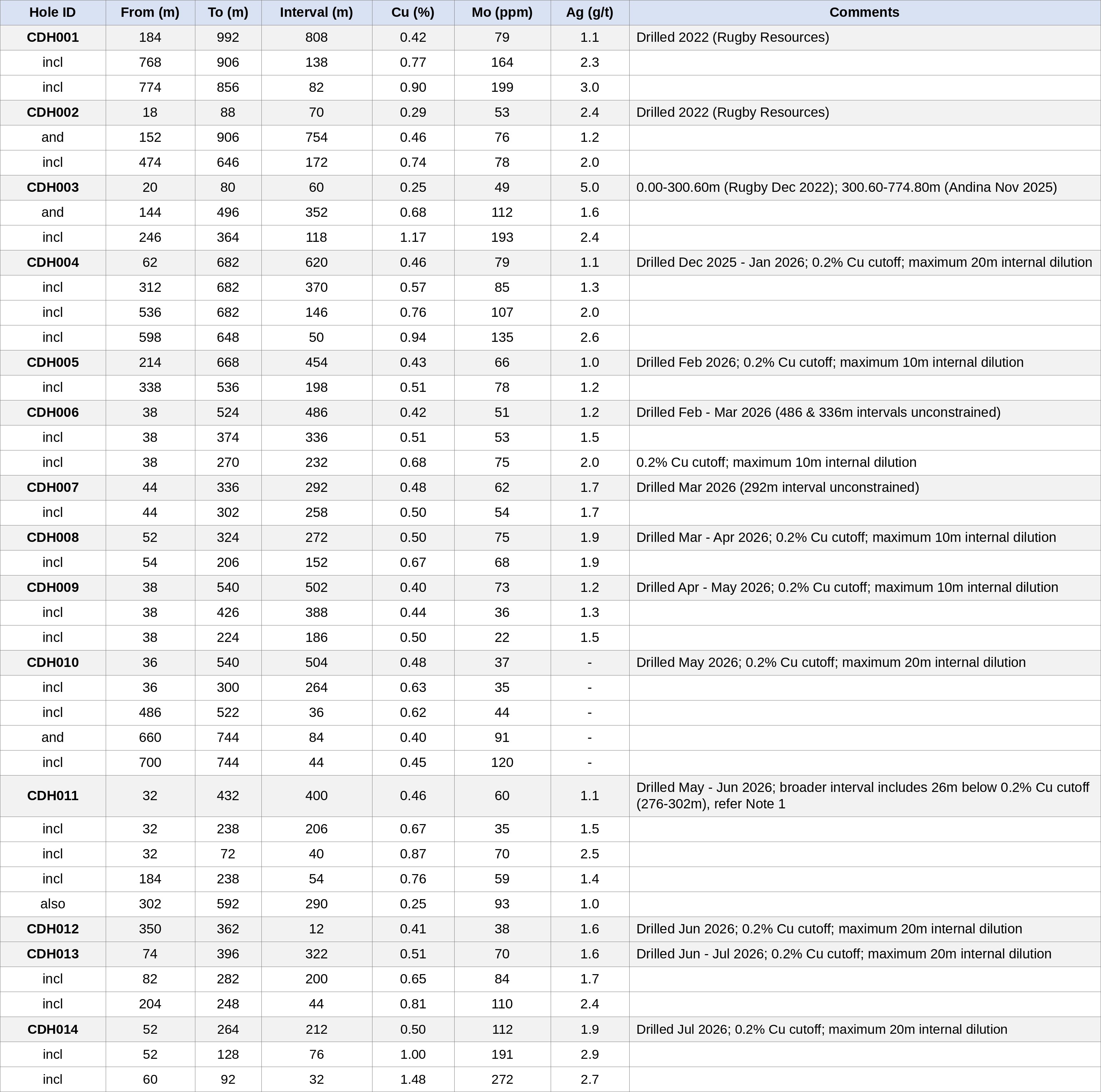
Table 1: Cobrasco Project - Significant Drill Intercepts
To view an enhanced version of this graphic, please visit:
https://images.newsfilecorp.com/files/12760/322646_52363fd4641168a5_004full.jpg
Note 1: CDH014 intervals were calculated using a nominal 0.2% Cu cutoff and a maximum internal dilution of 20m, consistent with the criteria applied to CDH004, CDH010 and CDH013, and are based on final assay certificates. Intervals for CDH001 to CDH013 are reproduced as previously reported and retain the reporting criteria described in the corresponding news releases. The previously reported 400m interval in CDH011 includes a 26m internal zone below the 0.2% Cu cutoff between 276m and 302m downhole.
Note 2: Reported interval widths are downhole lengths and may not represent the true widths of mineralization.
Table 2: Cobrasco Project - Drill Collar Parameters (WGS84, UTM Zone 18N)
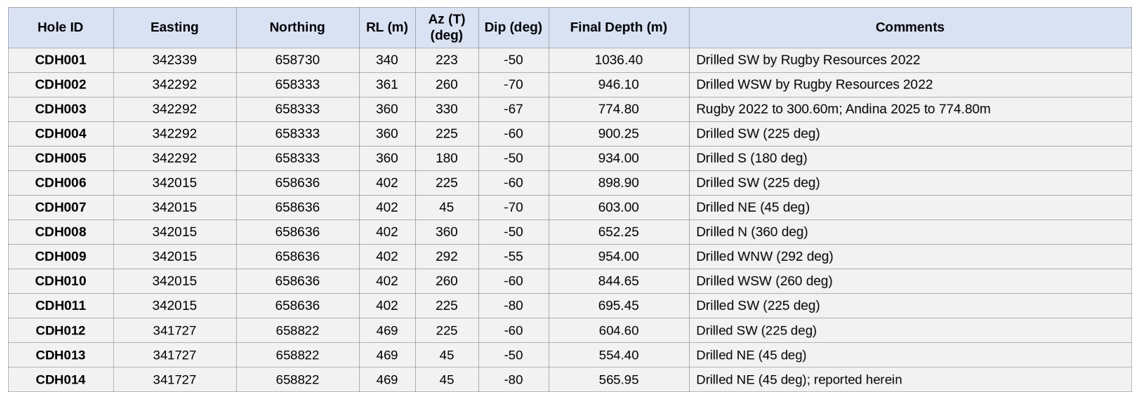
To view an enhanced version of this graphic, please visit:
https://images.newsfilecorp.com/files/12760/322646_table2.jpg
ABOUT ANDINA COPPER
Andina Copper Corporation is a unique South America-focused copper explorer listed on the TSX Venture Exchange (TSXV: ANDC), Frankfurt (FSE: FIR), and OTC (OTCQB: PMMCF) exchanges. The Company holds two significant discoveries along the world's premier copper producing Andean porphyry belt in Argentina and Colombia, and a compelling undrilled copper-gold target in the prolific copper production district of the Coastal Cordillera of Chile.
FORWARD-LOOKING STATEMENT
This news release contains certain statements that may be deemed "forward-looking statements". All statements in this release, other than statements of historical fact, that address events or developments that Andina Copper expects to occur, are forward-looking statements. Forward-looking statements are statements that are not historical facts and are generally, but not always, identified by the words "expects" and similar expressions, or that events or conditions "will" or "may" occur. These statements are subject to various risks. Although Andina Copper believes the expectations expressed in such forward-looking statements are based on reasonable assumptions, such statements are no guarantee of future performance, and actual results may differ materially from those in forward-looking statements.
Neither the TSX-V nor the Canadian Investment Regulatory Organization accepts responsibility for the adequacy or accuracy of this release.

To view the source version of this press release, please visit https://www.newsfilecorp.com/release/322646