News release
IDEX Intersects Evidence of a Magmatic-Hydrothermal System at the Shiver Target and Reports Initial 2026 Assays, Including 92.97 m of 0.39% Cu (0.67% CuEq) at Kismet, Freeze Project, Idaho USA
Discuss on
 $IDEX.V#18 trending on CEO.CA
Loading live prices…
(TheNewswire)
 | |||||||||
 |  | ||||||||
Vancouver, B.C., November 12th, 2026 – TheNewswire - IDEX Metals Corp. (TSXV: IDEX / OTCQB: IDXMF) ("IDEX" or the "Company") is pleased to report that hole KSMT26020, the first drill hole at the Shiver Target (“Shiver”), has intersected porphyritic granodiorite with quartz-sericite-pyrite (QSP) alteration and D-type quartz-pyrite veins. These features are indicative of a nearby magmatic-hydrothermal system and speak to the potential scale of its footprint, with KSMT26020 collared approximately 1.6 km north-northeast of the Solstice discovery hole (KSMT26016) at the Freeze Property in Washington County, western Idaho (“Freeze”, or the “Property”). With Shiver, the Company has now intersected mineralization – or related hydrothermal alteration – at three targets (Kismet, Solstice and Shiver) along a north-northeast-trending mineralized corridor that spans nearly 3 km, most of which has never been drilled (see Figure 6 below). The Company is also reporting assays for the first six holes of its 2026 drill program; this includes hole KSMT26012 at the Kismet Target, which intersected 92.97 m of 0.39% copper, 308 ppm molybdenum and 2.04 g/t silver, or 0.67% copper equivalent ("CuEq"), from 247.05 m downhole. The interval includes 25.40 m of 0.96% Cu (1.38% CuEq), which is hosted in a potassic-altered breccia approximately 220 to 300 m below surface, demonstrating an extension of higher-grade copper at Kismet to depth.
-
Evidence of magmatic-hydrothermal system at Shiver: KSMT26020, the first hole at the Shiver Target, encountered porphyritic granodiorite at 55 m and intersected D-type quartz-pyrite veins, pyrite in veins, and increasing dissemination downhole, with QSP-altered porphyritic granodiorite observed from 189.4 to 196.0 m. These features indicate proximity to a magmatic-hydrothermal system. Shiver lies approximately 1.6 km north-northeast of the Solstice discovery. These are visual observations based on initial core logging, and assays are pending.
-
A nearly 3 km mineralized corridor: Kismet and Solstice have each intersected copper mineralization, including porphyry-style mineralization at Solstice, and alteration / D-type veining at Shiver indicating a nearby magmatic-hydrothermal system. The three targets are aligned along a north-northeast corridor. Shiver lies approximately 2.8 km north-northeast of Kismet, and prime in-fill target areas (the 1.2 km strike between Kismet and Solstice, and 1.6 km between Solstice and Shiver) have yet to be drill tested
-
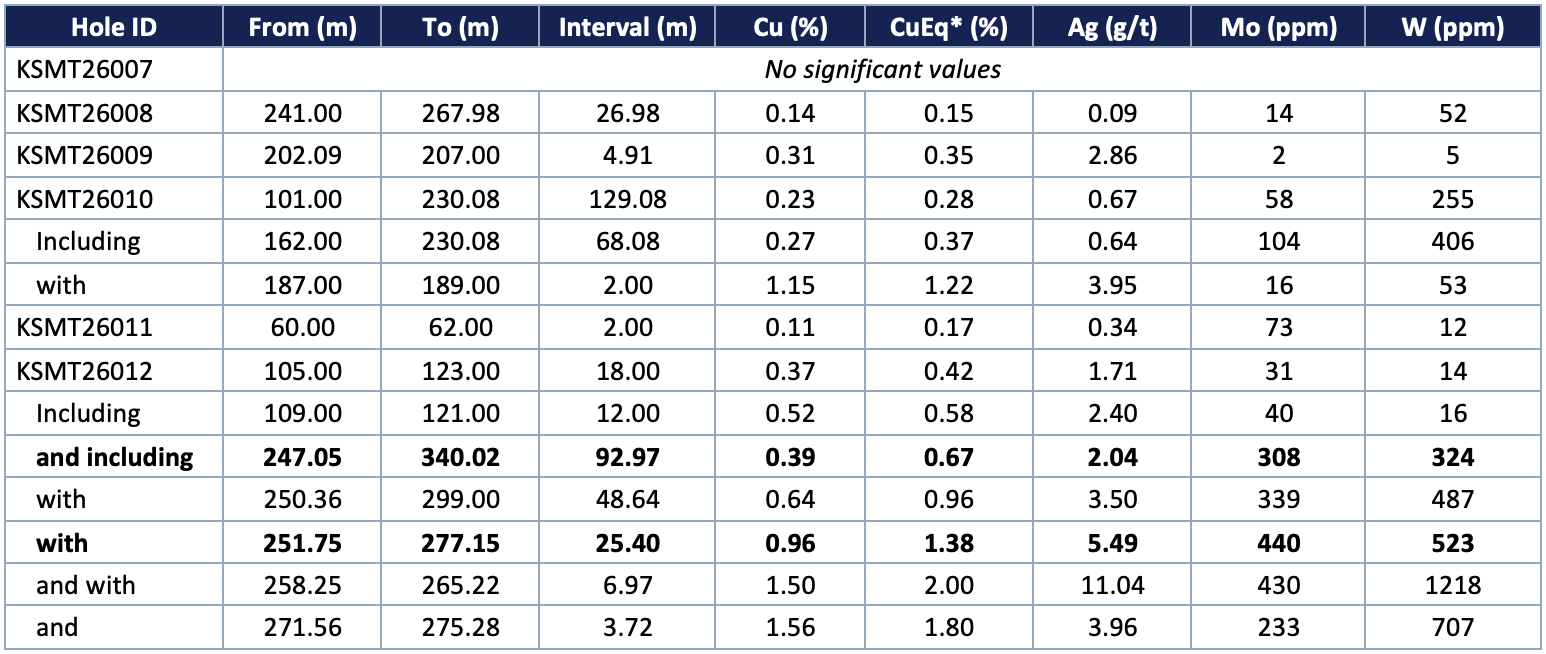
KSMT26012 returns the best copper grades of the 2026 program to date: 92.97 m of 0.39% Cu, 308 ppm Mo and 2.04 g/t Ag (0.67% CuEq) from 247.05 m; including 25.40 m of 0.96% Cu, 440 ppm Mo and 5.49 g/t Ag (1.38% CuEq), which includes 6.97 m of 1.50% Cu, 430 ppm Mo and 11.04 g/t Ag (2.00% CuEq).
-
Broad copper-tungsten mineralization in KSMT26010: 129.08 m of 0.23% Cu (0.28% CuEq) from 101.00 m, including 68.08 m of 0.27% Cu, 104 ppm Mo and 406 ppm tungsten ("W") (0.37% CuEq) from 162.00 m.
-
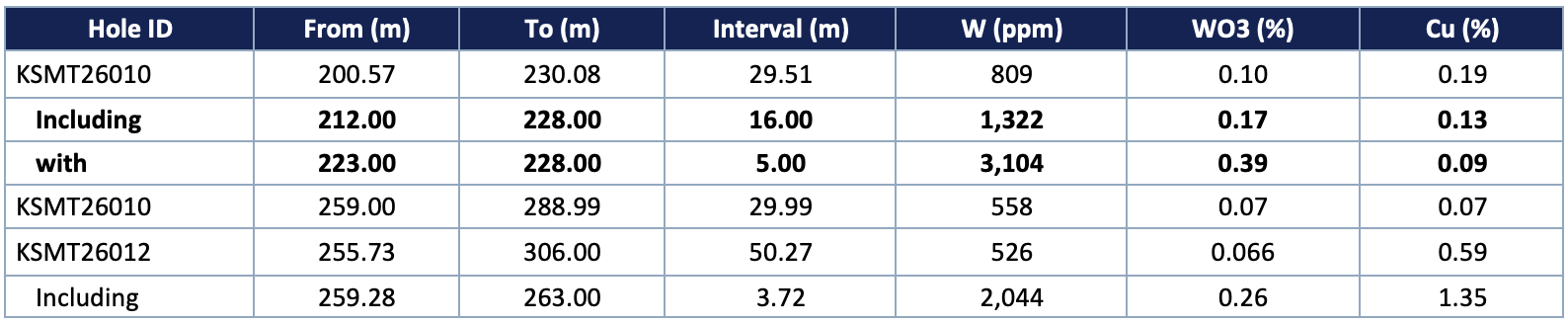
High-grade tungsten in KSMT26010: 16.00 m of 1,322 ppm W (0.17% WO3) from 212.00 m, including 5.00 m of 3,104 ppm W (0.39% WO3) from 223.00 m, within 29.51 m of 809 ppm W (0.10% WO3). KSMT26012 also returned 50.27 m of 526 ppm W (0.066% WO3) from 255.73 m, overlapping its main copper interval.
-
More results to come: Assays are pending for KSMT26013 through KSMT26018, including the Solstice porphyry-style discovery hole (KSMT26016) and four additional holes at Kismet. Core from KSMT26019 (Solstice) and KSMT26020 (Shiver) will be sampled and submitted as drilling is completed.
Significant Intercepts
Click Image To View Full Size
Table 1: Significant intercepts from 2026 drill holes KSMT26007 to KSMT26012 at the Freeze Property. Intervals are core lengths; true widths are not yet known. Significant intercepts were calculated using a 0.10% Cu cut-off and may include individual samples or intervals less than this. *CuEq is calculated as described below. Gold assays for KSMT26012 are pending; gold values in KSMT26007 to KSMT26011 were not significant.
Significant Tungsten Intercepts
Click Image To View Full Size
Table 2: Significant tungsten intercepts from 2026 drill holes. Intervals are core lengths; true widths are not yet known. Intercepts were calculated using a 100 ppm W cut-off. WO3 (%) = W (ppm) x 1.2611 / 10,000. Refer to Table 1 for significant copper intercepts that overlap with and are included in the calculated tungsten intervals.
Drill Hole Locations
Click Image To View Full Size
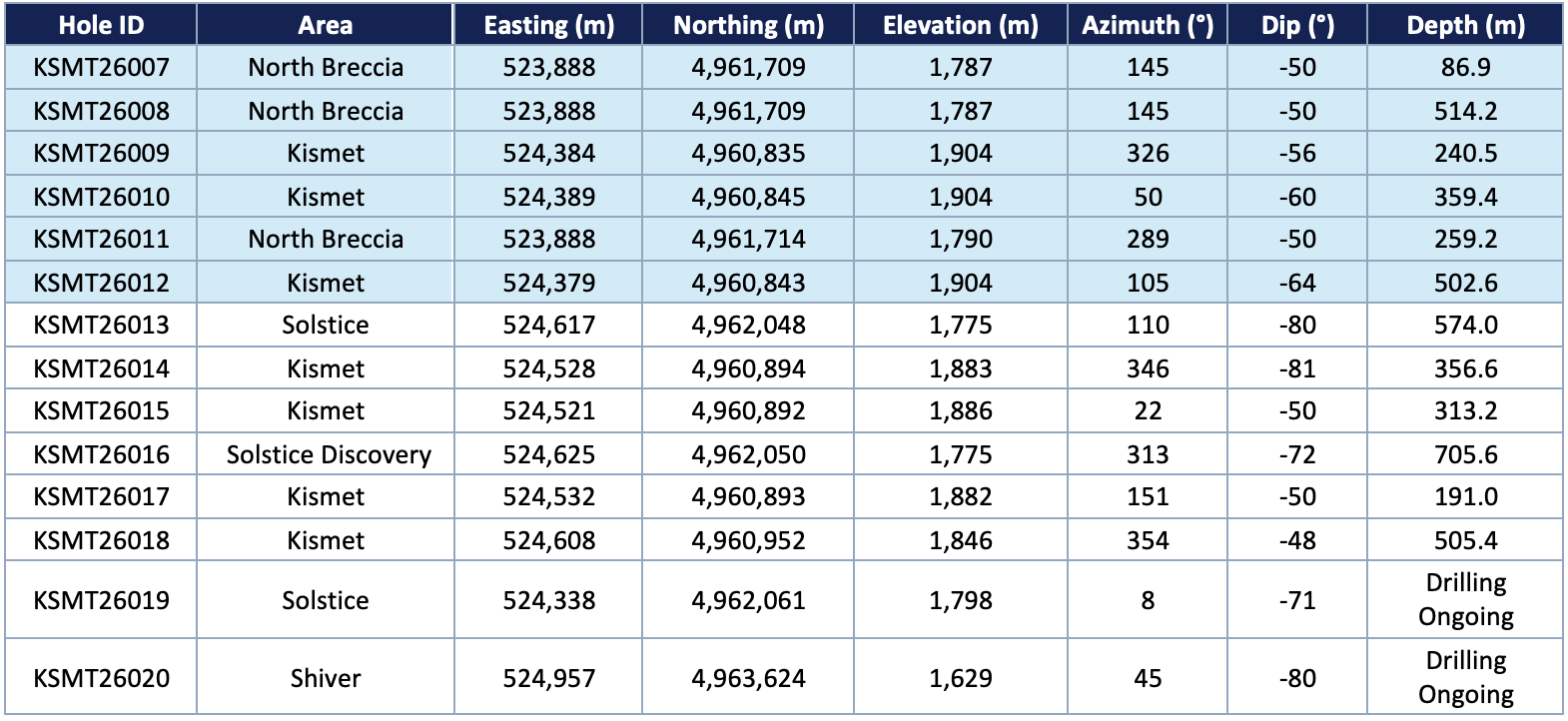
Table 3: Collar locations of the 2026 drill holes at the Freeze Property to date. Holes reported in this news release (KSMT26007 to KSMT26012) are highlighted. KSMT26019 and KSMT26020 were in progress at the time of this release. Coordinates are NAD83 UTM Zone 11N taken with a handheld GPS; azimuth and dip are at the collar. KSMT26007 deviated in the casing at approximately 36 m depth and was continued as KSMT26008 from the same collar set-up.
Click Image To View Full Size
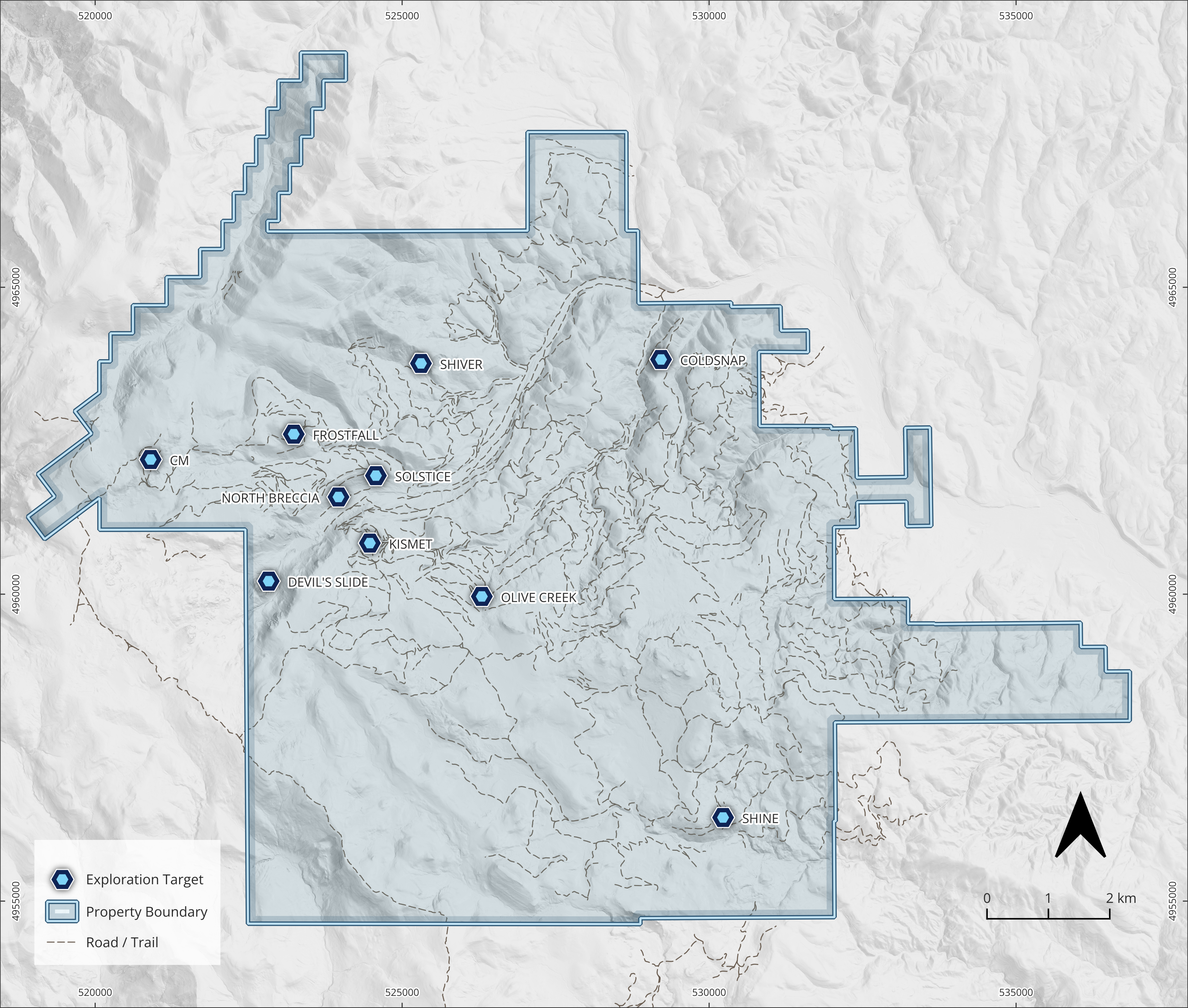
Figure 1: Freeze Property, Washington County, Idaho, showing claim boundaries and exploration targets, including Kismet, North Breccia and Solstice.
KSMT26012: Copper and Molybdenum in Breccia at Depth
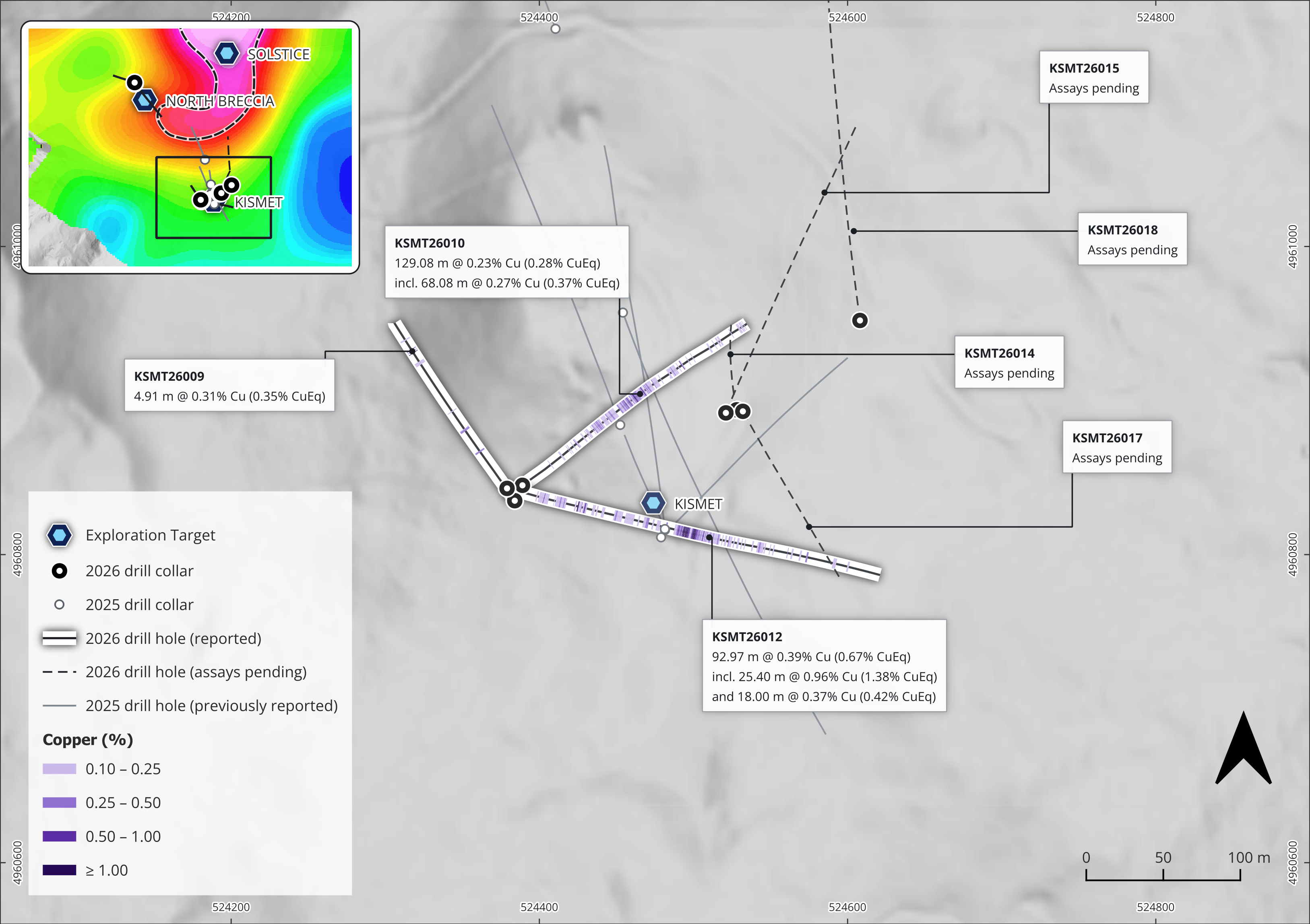
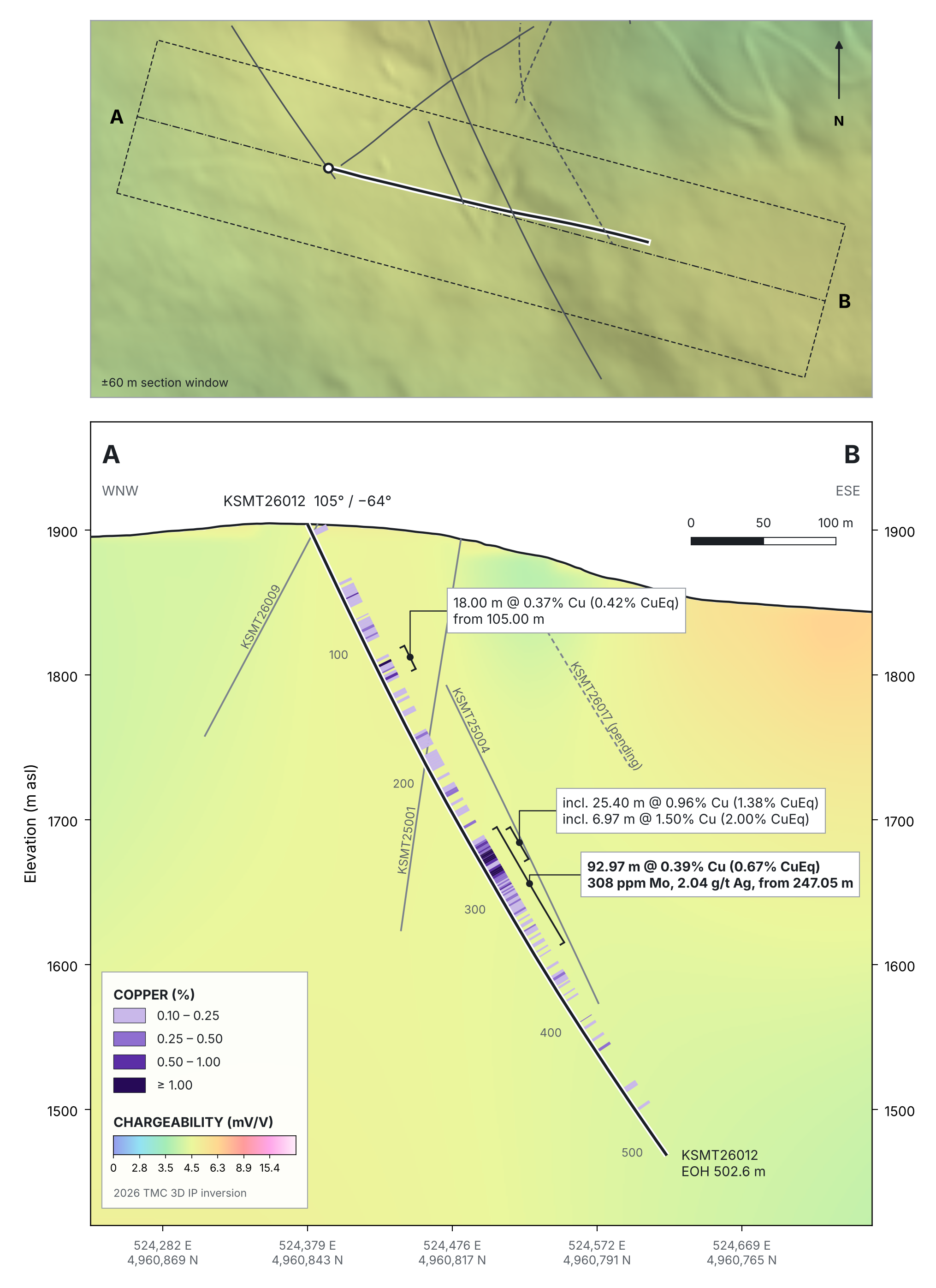
KSMT26012 was drilled at an azimuth of 105 degrees and a dip of -64 degrees to a final depth of 502.62 m. The hole was designed to test the Kismet Breccia Complex to the east-southeast and at greater depths versus previous drilling.
From surface to 241 m, KSMT26012 intersected diorite with silica, argillic and sericite alteration. A shallower copper zone within this interval returned 18.00 m of 0.37% Cu, 31 ppm Mo and 1.71 g/t Ag (0.42% CuEq) from 105.00 m.
At 241 m the hole entered a breccia body that continues to 460 m downhole. The upper part of the breccia (241 to 315 m) is a framework-style breccia of porphyritic granodiorite, progressing downward into matrix-supported breccia with a quartz monzonite matrix. Potassic alteration was logged from 241.7 m to final hole depth, locally overprinted with sericite, propylitic and silica.
The main copper interval coincides with the top of the breccia. It returned 92.97 m of 0.39% Cu, 308 ppm Mo and 2.04 g/t Ag (0.67% CuEq) from 247.05 m, including 25.40 m of 0.96% Cu, 440 ppm Mo and 5.49 g/t Ag (1.38% CuEq), which includes 6.97 m of 1.50% Cu, 430 ppm Mo and 11.04 g/t Ag (2.00% CuEq). Tungsten is also elevated throughout this zone, with 50.27 m of 526 ppm W (0.066% WO3) from 255.73 m, including 3.72 m of 2,044 ppm W (0.26% WO3) from 259.28 m, coinciding with the highest-grade copper in the hole. Below the copper zone, molybdenum remains elevated, averaging 225 ppm Mo over 95.46 m from 307.54 m.
Click Image To View Full Size
Figure 2: Plan view of the Kismet target showing 2026 drill holes KSMT26009, KSMT26010 and KSMT26012 coloured by copper grade, with previously reported 2025 drill hole traces. Significant 2026 intercepts are labelled; dashed traces are 2026 holes with assays pending. Inset shows the 2026 holes at Kismet and North Breccia (KSMT26007, KSMT26008 and KSMT26011) on 2026 IP chargeability at 450 m depth (see Figure 6 for mV ranges).
Click Image To View Full Size
Figure 3: Cross-section A-B (looking north-northeast) along KSMT26012 at Kismet, showing copper grade over 2026 IP chargeability. Holes within 60 m of the section are projected onto it.
KSMT26010 was drilled from the same pad as KSMT26012 at an azimuth of 50 degrees and a dip of -60 degrees, to a final depth of 359.36 m. It returned a broad zone of 129.08 m of 0.23% Cu (0.28% CuEq) from 101.00 m, including 68.08 m of 0.27% Cu, 104 ppm Mo and 406 ppm W (0.37% CuEq) from 162.00 m.
KSMT26010 also returned the highest tungsten grades of the 2026 program to date: 29.51 m of 809 ppm W (0.10% WO3) from 200.57 m, including 16.00 m of 1,322 ppm W (0.17% WO3) and 5.00 m of 3,104 ppm W (0.39% WO3) from 223.00 m (see Table 2). A second tungsten zone returned 31.99 m of 558 ppm W (0.07% WO3) from 259.00 m. The tungsten-rich intervals lie at the base of, and below, the copper zone in this hole, and are consistent with the tungsten enrichment previously reported in all six 2025 Kismet holes.
KSMT26009 was drilled to the northwest from the same pad at an azimuth of 326 degrees and a dip of -56 degrees to 240.49 m depth. It returned 4.91 m of 0.31% Cu and 2.86 g/t Ag (0.35% CuEq) from 202.09 m.
North Breccia: KSMT26007, KSMT26008 and KSMT26011
Holes KSMT26007, KSMT26008 and KSMT26011 were drilled from the North Breccia Target, approximately 800 m west of the Solstice Target. KSMT26007 was drilled to 86.87 m depth, though deviated at 36 m after cementing, and was subsequently continued as holes KSMT26008 from this depth. KSMT26008, reached a depth of 514.20 m. KSMT26011 was drilled to the west-northwest and was stopped at 259.19 m after encountering artesian water.
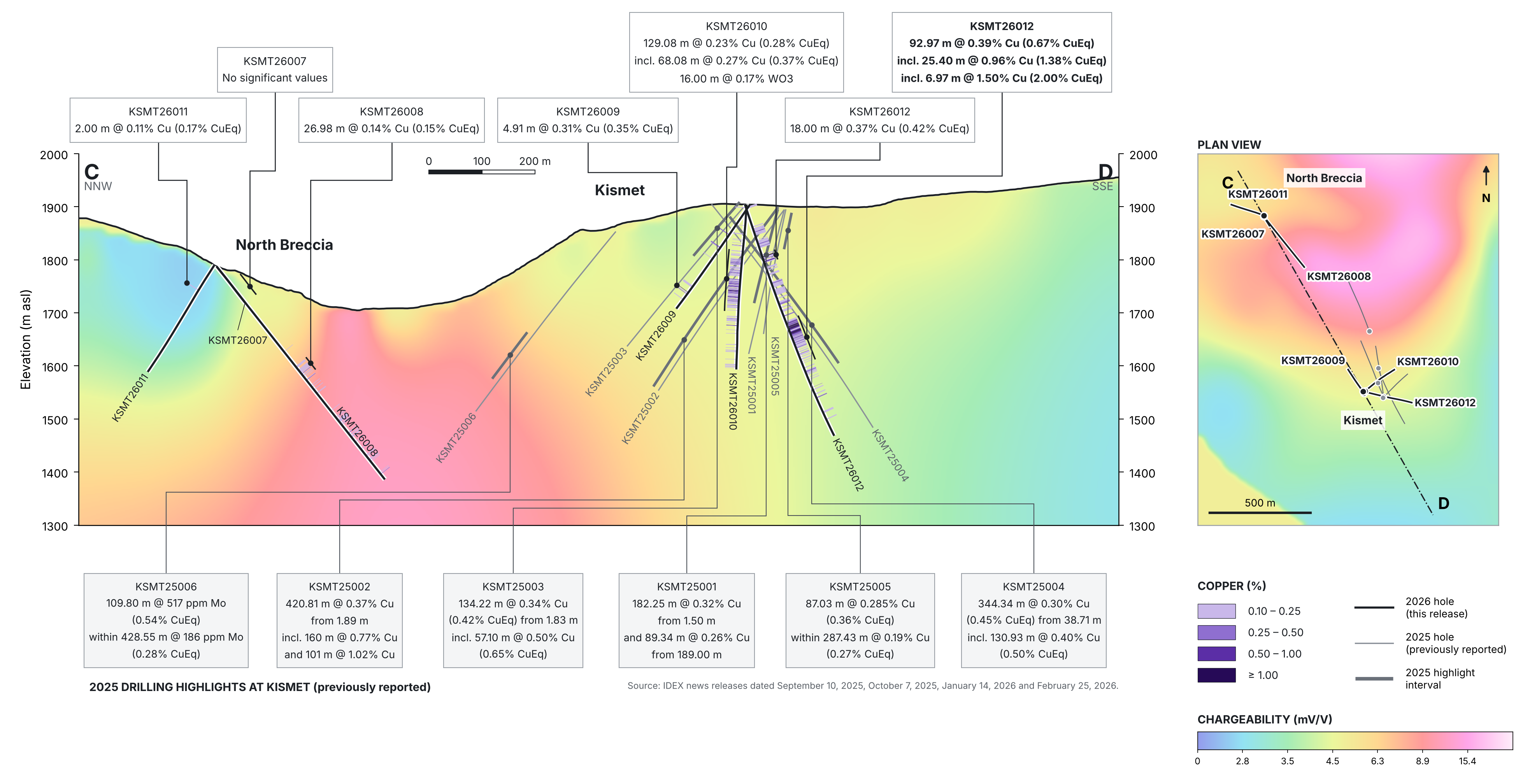
KSMT26008 returned 26.98 m of 0.14% Cu (0.15% CuEq) from 241.00 m, and KSMT26011 returned 2.00 m of 0.11% Cu, 73 ppm Mo and 0.34 g/t Ag (0.17% CuEq) from 60.00 m. KSMT26007 returned no significant values. These holes lie on the western margin of the Solstice chargeability anomaly, and the Company interprets them as having tested the periphery of the system. Drilling at Solstice has since shifted to the east, where KSMT26016 intersected porphyry-style mineralization (see news release dated October 22, 2026).
Click Image To View Full Size
Figure 4: Long section C-D (looking east-northeast) from North Breccia to Kismet showing all 2026 drill holes reported in this release (KSMT26007 to KSMT26012), coloured by copper grade, with significant intercepts, over 2026 IP chargeability. All holes are projected onto the section line; KSMT26010 and KSMT26012 were drilled oblique to the section and appear foreshortened. Previously reported 2025 holes at Kismet are shown in grey trace lines, with their highlight intervals called out below the section (from IDEX news releases dated September 10, 2025, October 7, 2025, January 14, 2026 and February 25, 2026).
KSMT26012 enhances the Company's understanding of Kismet in three important ways:
-
Copper continues at depth. KSMT26012 demonstrates that high-grade copper extends roughly 220 to 300 m below surface, at a similar elevation to deeper higher-grade intervals previously reported in KSMT25001 and KSMT25004, with breccia remaining present to 460 m.
-
The deeper mineralization is potassic. The copper interval sits at the top of a potassic-altered breccia, and molybdenum remains elevated below the copper zone.
-
Kismet remains open. Mineralization has not been closed off to the north, east-southeast, and remains open at depth. The Company is awaiting assays from four additional holes at Kismet (KSMT26014, KSMT26015, KSMT26017 and KSMT26018) to further test its extent.
Clayton Fisher, CEO of IDEX Metals, commented, "KSMT26012 has returned the best copper grades of our 2026 program so far, and they come from deeper in the Kismet system than most of our previous drilling. Seeing close to 1% copper in a potassic-altered breccia, with molybdenum and tungsten alongside it, tells us that Kismet continues at depth and is not a closed-off, near-surface system. What has us most excited now is Shiver. Our very first hole there has intersected the same porphyritic granodiorite host seen at Solstice (1.6 km to the south), with QSP alteration and D-type veins telling us we’re close to a magmatic-hydrothermal system. With Kismet, Solstice and Shiver, we now have a mineralized corridor nearly 3 km long, with porphyry-style mineralization at Solstice and evidence of a nearby magmatic-hydrothermal system at Shiver, and almost none of the ground between them has been drilled. A prospective footprint of that size is what exploration companies dream about, and it opens up years of fresh catalysts ahead for IDEX. We still need assays to tell us what Shiver and Solstice contain, but we have never had more reasons to keep drilling at Freeze."
Drilling Update: Shiver and Solstice
Two drills are currently active at Freeze. The following observations are preliminary and visual in nature.
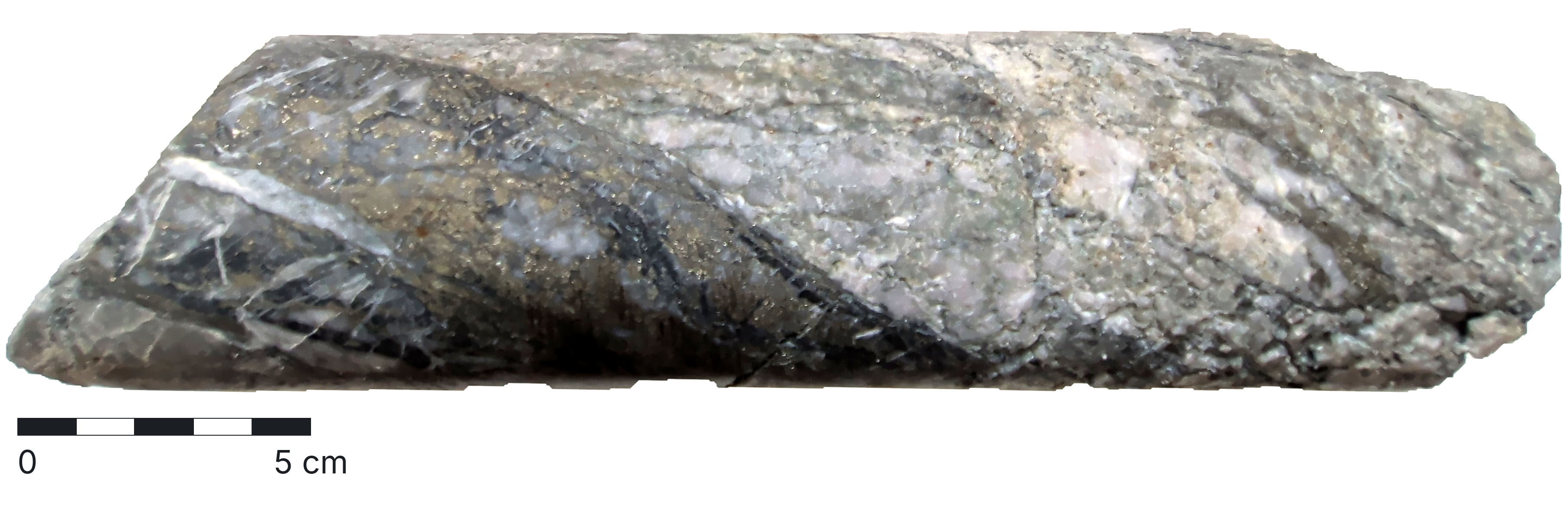
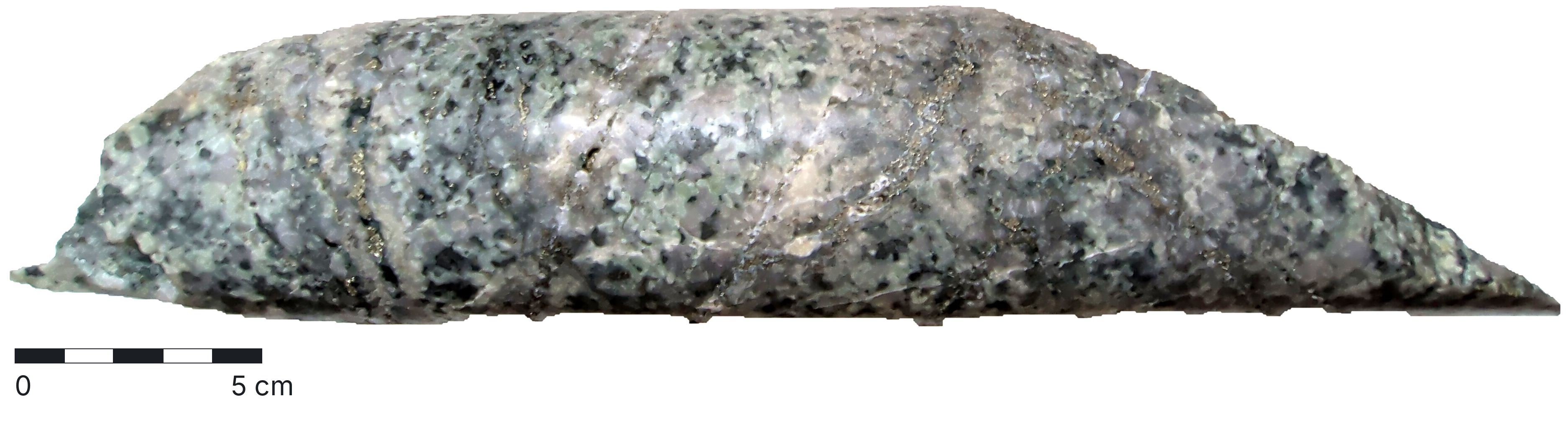
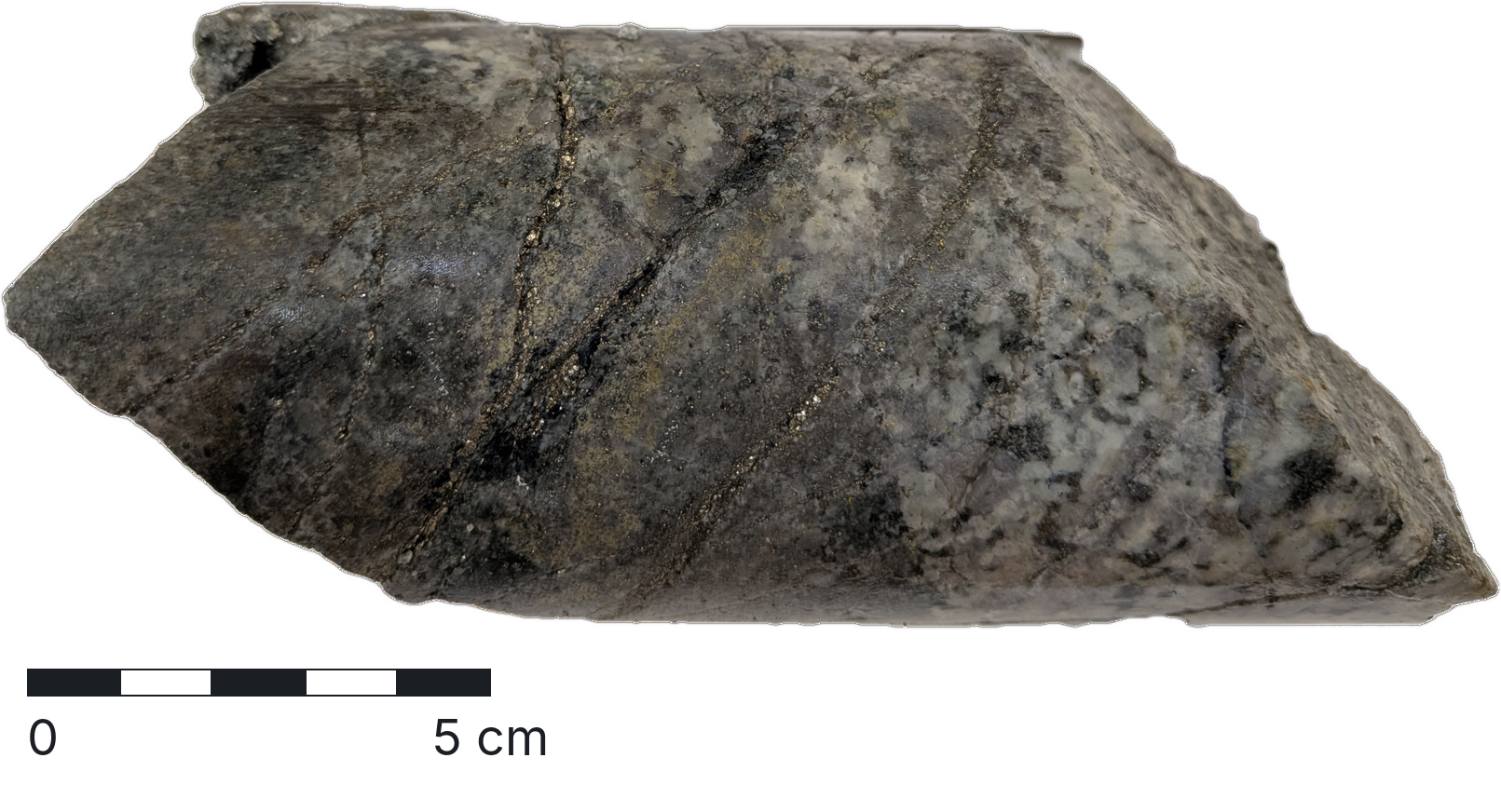
Shiver (KSMT26020): KSMT26020 is the first drill hole at the Shiver target, approximately 1.6 km north-northeast of KSMT26016 and 2.8 km north-northeast of Kismet, and is being drilled at an azimuth of 45 degrees and a dip of -80 degrees. Below overburden and gabbro, the hole entered porphyritic granodiorite at 55 m, the same intrusive host that carries the porphyry-style mineralization at Solstice. Argillic alteration near the top of the intrusion passes downward into propylitic and silica alteration, with pyrite in veins and disseminations that increases downhole with chalcopyrite logged locally. A strongly faulted zone from approximately 167 to 189 m slowed drilling, and the hole was reduced to NQ diameter at 188 m. Below the fault, QSP-altered porphyritic granodiorite with D-type quartz-pyrite veins was logged from 189.4 to 196.0 m, followed by porphyritic granodiorite cut by aplite and a porphyritic dyke to 231 m as of November 4, 2026. D-type quartz-pyrite veins and pyrite stringers also occur above the fault, including at 140.85 m, 153.67 m and 178.24 m (Figure 5). Drilling is continuing.
D-type quartz-pyrite veins with QSP alteration, in a porphyritic intrusion cut by later porphyry and aplite dykes, are characteristic of the upper and outer parts of porphyry copper systems (Sillitoe, 2010). KSMT26020 has not intersected porphyry-style stockwork, but in the Company's interpretation the veining and alteration indicate that the hole is proximal to a magmatic-hydrothermal system. The hole is being extended to test for higher-temperature alteration and veining at depth.
Solstice (KSMT26019): KSMT26019 is the first follow-up hole to the KSMT26016 porphyry discovery. It was collared approximately 290 m west of KSMT26016 and is being drilled to the north at a dip of -70 degrees. Below basalt and a thin volcaniclastic unit, the hole entered porphyritic granodiorite at 168.5 m and has remained in it to a depth of 608 m as of November 8, 2026. Chalcopyrite, pyrite and molybdenite have been observed at intervals from 187.7 m downhole, in veins and disseminated in the groundmass, with quartz-sericite-pyrite (QSP) alteration increasing in intensity with depth. Quartz vein stockwork, including possible B- and D-type veins, has been logged from approximately 390 m. Drilling is continuing.
Cautionary statement: The observations of KSMT26019 and KSMT26020 above are based on preliminary visual logging of drill core and are not a substitute for laboratory analysis. Visual estimates of sulphide minerals should not be taken as an indication of the grade, width or economic significance of any mineralization. Samples will be submitted for assay, and results will be reported once received and validated.
Click Image To View Full Size
Click Image To View Full Size
Click Image To View Full Size
Figure 5: Representative drill core from KSMT26020 at the Shiver target. Top: 140.85 to 141.10 m, banded D-type quartz-pyrite vein with fine-grained pyrite along its margins, cutting veined, silicified wallrock. Middle: 153.67 to 153.82 m, porphyritic granodiorite cut by thin D-type pyrite stringers. Bottom: 178.24 to 178.35 m, altered porphyritic granodiorite cut by a sheeted set of D-type pyrite stringers. Core is HQ diameter (63.5 mm); all three photos are shown at the same scale. Observations are visual only and are not a substitute for laboratory analysis.
A Nearly 3 km Mineralized Corridor: How Kismet, Solstice and Shiver Fit Together
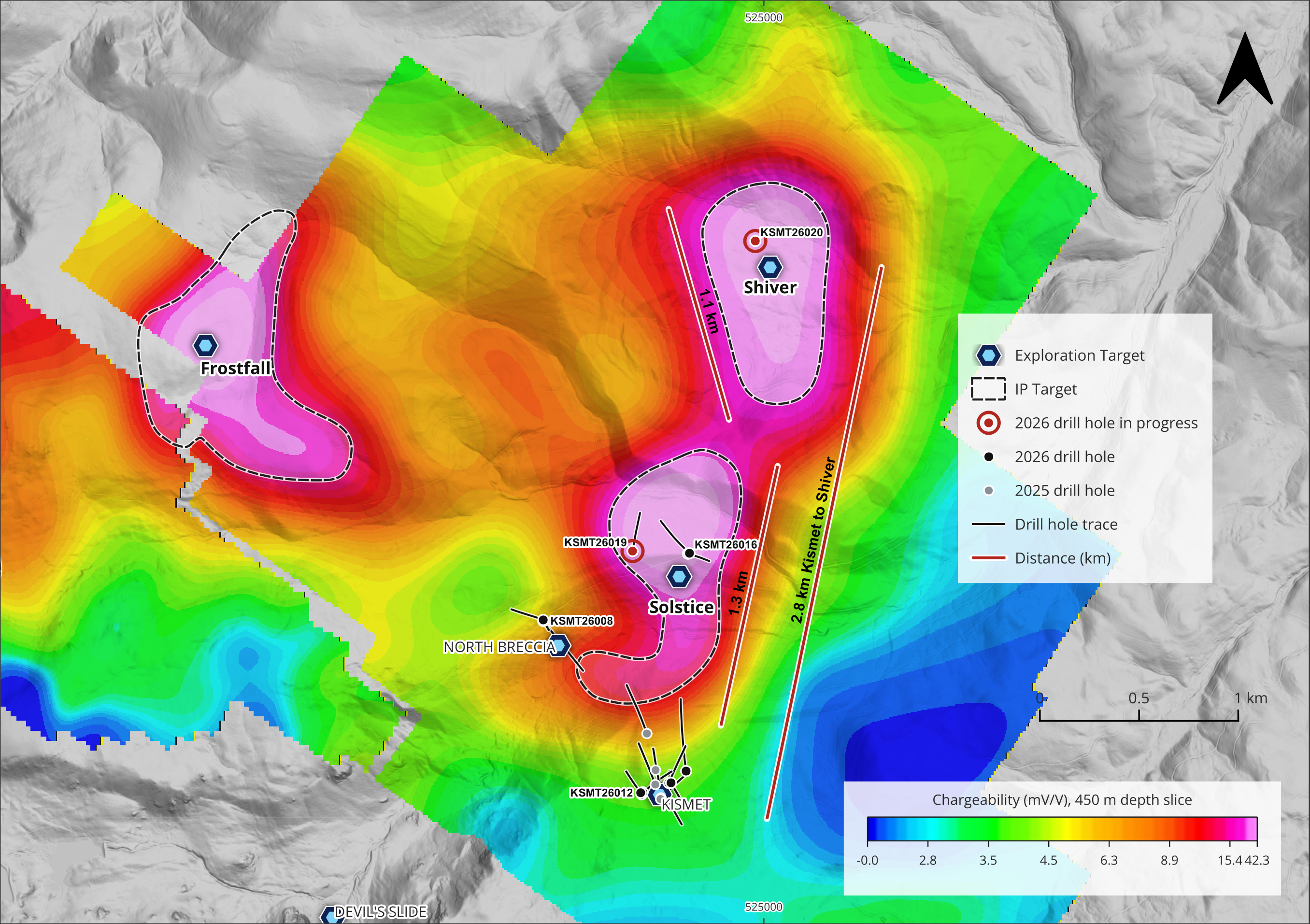
Drilling in 2025 and 2026 has now intersected mineralization at three targets on the Freeze Property, aligned along a north-northeast mineralized corridor that spans nearly 3 km from Kismet in the south to Shiver in the north (Figure 6):
-
Kismet: copper, molybdenum, silver and tungsten in a potassic-altered tourmaline breccia, with the best grades to date between approximately 220 and 300 m below surface (this release and previously reported 2025 drilling).
-
Solstice, 1.2 km north-northeast of Kismet: porphyritic granodiorite with chalcopyrite, molybdenite and quartz vein stockwork, including possible B- and D-type veining, in KSMT26016 and KSMT26019 (assays pending).
-
Shiver, 1.6 km north-northeast of Solstice: the same porphyritic granodiorite host with QSP alteration and D-type quartz-pyrite veins in KSMT26020, the first hole at the target, indicating a possible nearby magmatic-hydrothermal system (assays pending).
The porphyritic granodiorite that hosts the mineralization at Solstice and the veining at Shiver is also interpreted to occur as clasts within the breccia at Kismet, and both Kismet and Solstice carry copper and molybdenum mineralization. Together with their alignment, this suggests to the Company that Kismet, Solstice and Shiver may be related parts of one mineralized corridor, with breccia-hosted copper at Kismet and porphyry-style mineralization at Solstice and a related magmatic-hydrothermal system indicated at Shiver. This interpretation is preliminary and will be advanced with assays from Solstice and Shiver and by further drilling.
Most drilling at Freeze to date has been concentrated at Kismet. Solstice has been tested by three holes and Shiver by one, and the ground between the targets has not been drilled. The Company views the corridor as a multi-year drilling opportunity, with step-out drilling at Solstice and Shiver and first tests of the gaps between them as priorities for the next phase of work.
Click Image To View Full Size
Figure 6: Plan view of the Freeze Property showing the Kismet, Solstice and Shiver targets, 2025 and 2026 drill holes, the 2.8 km distance from Kismet to Shiver, and the lengths of the Solstice (1.3 km) and Shiver (1.1 km) chargeability anomalies, on 2026 IP chargeability at 450 m depth. KSMT26019 and KSMT26020 were in progress at the time of this release.
-
Assays pending: Samples from KSMT26013 to KSMT26018 have been or are in the process of being submitted to AGAT Laboratories in Calgary, Alberta, including the Solstice discovery hole KSMT26016. Results will be released once received and validated.
-
Drilling ongoing: KSMT26019 is following up KSMT26016 at Solstice, and KSMT26020 is the first drill test of the Shiver target. Samples from both holes will be submitted for assay once drilling is complete.
-
Next phase planning: The Company is planning follow-up drilling at Shiver and Solstice and first tests of the untested ground between Kismet, Solstice and Shiver.
Copper Equivalent Calculation
Copper equivalent (CuEq) values are calculated using metal prices of US$3.75/lb Cu, US$30/lb Mo and US$35/oz Ag, consistent with the Company's previous disclosure. CuEq (%) = Cu (%) + [Mo (ppm) x 0.0008] + [Ag (g/t) x 0.0136]. Metallurgical recoveries of 100% are assumed to be equal for all metals; no metallurgical testwork has been completed on the Freeze Property. Tungsten and gold are not included in the CuEq calculation.
QA/QC
Drill core is HQ diameter, reduced to NQ at depth where required, and is logged and photographed at the Company's core facility in Council, Idaho. Core is cut in half, with one half submitted for analysis and the other retained for reference. Samples were shipped under chain of custody to AGAT Laboratories in Calgary, Alberta, an ISO 17025 accredited laboratory, where they were dried, crushed and pulverized. Copper, molybdenum, silver, tungsten and other elements were analyzed by AGAT sodium peroxide fusion method 201-378. Gold was analyzed by fire assay with an AAS finish (AGAT method 202-051). The Company's QA/QC program includes the insertion of certified reference materials, blanks and field and pulp duplicates into the sample stream, in addition to the laboratory's internal quality control.
Qualified Person
The scientific and technical information contained in this news release has been reviewed and approved for disclosure by David Hladky, P.Geo. (registered in Alberta), V.P. Exploration of IDEX Metals Corp., who is a "Qualified Person" as defined by National Instrument 43-101.
About IDEX Metals Corp.
IDEX Metals Corp. is a mineral exploration company focused on advancing a portfolio of base and precious metal projects in Idaho, USA. IDEX is primarily focused on the exploration and development of the Freeze Copper-Gold porphyry prospect located in the newly discovered Idaho Copper Belt, Washington County, Idaho. With a strategic land position in a great mining jurisdiction and surrounded by major industry players, IDEX is committed to redefining district-scale exploration in Idaho.
ON BEHALF OF THE BOARD OF DIRECTORS
Clayton Fisher
CEO & Director
For further information regarding IDEX contact:
Investor Relations
Email: info@idexmetals.com
Phone: 1 (604) 260-0356
Cautionary Note Regarding Forward-Looking Statements
This news release contains forward-looking statements and forward-looking information within the meaning of applicable securities laws. Forward-looking statements include, but are not limited to, statements regarding the interpretation of drill results at Kismet and North Breccia, the interpretation of visual observations at Shiver and Solstice, the interpretation that Kismet, Solstice and Shiver form part of a single mineralized corridor, the continuity and extent of mineralization, the expected timing of pending assay results, the interpretation of a porphyry system at Freeze, and the Company's future exploration plans. These statements are based on current expectations and assumptions and involve known and unknown risks and uncertainties, including that further drilling and assays may not confirm the continuity or grade of mineralization, that geological interpretations may change, and risks related to financing, permitting, weather and field conditions. Actual results may differ materially from those expressed or implied. Readers are cautioned not to place undue reliance on forward-looking statements. The Company disclaims any obligation to update forward-looking statements, except as required by applicable securities laws.
Neither the TSX Venture Exchange nor its Regulation Services Provider (as that term is defined in the policies of the TSX Venture Exchange) accepts responsibility for the adequacy or accuracy of this release.
Copyright (c) 2026 TheNewswire - All rights reserved.